I know I have written about Egypt's Jews before. Just the same, I saw this article today and thought it was interesting -- and sad.
"Mr. Obama had harsh things to say to the Arab world about its treatment of women. And he said much about America’s debt to Islam. But he failed to remind the Egyptians in his audience that until 50 years ago a strong and vibrant Jewish community thrived in their midst. Or that many of Egypt’s finest hospitals and other institutions were founded and financed by Jews. It is a shame that he did not remind the Egyptians in the audience of this, because, in most cases — and especially among those younger than 50 — their memory banks have been conveniently expunged of deadweight and guilt. They have no recollections of Jews."
So true -- the people my age in Egypt have very little idea of what their country is missing. They know that their parents or grandparents used to have Jewish friends and spoke positively of them in many cases, but they have no idea about the cultural legacy they have lost.
Showing posts with label news you can use. Show all posts
Showing posts with label news you can use. Show all posts
Tuesday, June 9, 2009

Sunday, June 7, 2009
the cairo speech
Obama was in Cairo Thursday to address the Muslim world from Cairo University, and though I was only able to watch the speech on CNN International just like everyone else, I wanted to share some thoughts anyway.
First, the atmosphere in the city all day (well, even all week leading up to this) was pretty interesting: there was a lot of anticipation for the speech, and Cairo got a pretty impressive sprucing up. Freshly painted bridges, redrawn traffic lanes on major roads, working street lights in the more bustling areas of the city, and an additional effort to get rid of the garbage normally clogging the city's few fractured sidewalks.
Every taxi I got in last week, when the driver figured out I was American (usually they assume Egyptian...until I start speaking Arabic with my very obvious accent), the first questions they would ask was whether I was excited about Obama, the speech, what did I think he would say, etc. Most Egyptians seemed to cautiously optimistic -- they felt that Obama was coming out on a limb by coming to Egypt and promising to address the Muslim world, and they hoped he would live up to their expectations. The fact that Obama was coming was all anyone could talk about -- and it was really refreshing for me to see how highly anticipated the leader of my country was in a place where, prior to November, invoking the name of the previous leader (Bush) led only to snide remarks and sneers of disapproval. (And yes, I am guilty of both snide remarks and sneers of disapproval when it comes to discussing Bush and his policies.)
Then there was the day of the speech itself. All schools were given the day off to curtail traffic and people in the streets, and many of my friends were given the day off from work. My gym was closed ("in honor of Obama's visit to Cairo" according to a sign), as were many other businesses. Mostly this was because everyone wanted to watch the speech (live at 1:15 pm), and also an attempt by the government to keep car and foot traffic to a minimum on the day of the speech. Cairo University, in Giza, was completely blocked off for blocks in all directions, making it completely impossible to come anywhere near the school. I had thought about going to see if there would be protesters or something, but it was pretty clear from photos I saw that there were nothing but hundreds of extra armed soldiers and a surprising dearth of cars.
Cairo has a huge traffic problem, going through all hours of the day and spread through most of the city (residential area at 11 pm? Traffic still sucks...), so there was something almost spooky about the quiet streets everywhere, kind of like that scene in Vanilla Sky where Tom Cruise runs through a completely empty Times Square. No honking, no exhaust, no traffic jams -- sorry, Obama, but that's not the real Cairo experience. Anyway, it turns out that this car-free effect was achieved by closing down entire roads for hours at a time, resulting in horrible traffic in other parts of the city. Most people stayed home or worked from home if possible (luckily, I was able to do that) to avoid the traffic and the excessive police (because really, why deal with that if you don't have to). But following the reactions people had to the speech, in person and online (I think I finally found the point of Twitter, people!) was very enjoyable and educational.
If you missed it, you can find the whole text of the speech here.
First, the atmosphere in the city all day (well, even all week leading up to this) was pretty interesting: there was a lot of anticipation for the speech, and Cairo got a pretty impressive sprucing up. Freshly painted bridges, redrawn traffic lanes on major roads, working street lights in the more bustling areas of the city, and an additional effort to get rid of the garbage normally clogging the city's few fractured sidewalks.
Every taxi I got in last week, when the driver figured out I was American (usually they assume Egyptian...until I start speaking Arabic with my very obvious accent), the first questions they would ask was whether I was excited about Obama, the speech, what did I think he would say, etc. Most Egyptians seemed to cautiously optimistic -- they felt that Obama was coming out on a limb by coming to Egypt and promising to address the Muslim world, and they hoped he would live up to their expectations. The fact that Obama was coming was all anyone could talk about -- and it was really refreshing for me to see how highly anticipated the leader of my country was in a place where, prior to November, invoking the name of the previous leader (Bush) led only to snide remarks and sneers of disapproval. (And yes, I am guilty of both snide remarks and sneers of disapproval when it comes to discussing Bush and his policies.)
Then there was the day of the speech itself. All schools were given the day off to curtail traffic and people in the streets, and many of my friends were given the day off from work. My gym was closed ("in honor of Obama's visit to Cairo" according to a sign), as were many other businesses. Mostly this was because everyone wanted to watch the speech (live at 1:15 pm), and also an attempt by the government to keep car and foot traffic to a minimum on the day of the speech. Cairo University, in Giza, was completely blocked off for blocks in all directions, making it completely impossible to come anywhere near the school. I had thought about going to see if there would be protesters or something, but it was pretty clear from photos I saw that there were nothing but hundreds of extra armed soldiers and a surprising dearth of cars.
Cairo has a huge traffic problem, going through all hours of the day and spread through most of the city (residential area at 11 pm? Traffic still sucks...), so there was something almost spooky about the quiet streets everywhere, kind of like that scene in Vanilla Sky where Tom Cruise runs through a completely empty Times Square. No honking, no exhaust, no traffic jams -- sorry, Obama, but that's not the real Cairo experience. Anyway, it turns out that this car-free effect was achieved by closing down entire roads for hours at a time, resulting in horrible traffic in other parts of the city. Most people stayed home or worked from home if possible (luckily, I was able to do that) to avoid the traffic and the excessive police (because really, why deal with that if you don't have to). But following the reactions people had to the speech, in person and online (I think I finally found the point of Twitter, people!) was very enjoyable and educational.
If you missed it, you can find the whole text of the speech here.
Sunday, May 24, 2009
life on hold
Last week, Mohamed Alaa, the 12-year-old grandson of Egyptian President Hosni Mubarak, passed away. While the death of a child is undoubtedly tragic, I have to see that I have never seen anything like the mandatory nation-wide mourning that ensued. Popular radio station Nile FM banished its stacks of pop tracks and played only Islamic tracts or somber music for about 24 hours. On Thursday night I showed up at Harry's Pub with a group of friends, only to be told that all karaoke had been suspended "out of respect" for the Mubarak family. It seemed excessive to me, but apparently it's a national tradition here for life to literally be put on hold.
This month I've been enjoying the EU Film Club, which has been screening movies from different countries at European cultural centers around the city since the beginning of May. They screen a different movie from a different country each night, with that host country providing some (free, occasionally alcoholic) refreshments before the (free) film, which is why I believe they are so popular. So far I have seen movies from Ireland (Once -- I love that movie!) and Austria, with plans to see Italy's entry today and Greece's later this week.
Anyway, as I guess you can tell, there aren't a lot of particularly exciting things happening around here. I mean, life continues as usual: work is going well, I feel like I am making good progress with my Arabic classes (my tutor says my reading is improving, which I believe is thanks to those children's books I bought), and friends are also good. As for the apartment, well...the Internet we finally arranged for never quite worked the way it was supposed to, and after three months of fighting with Mobinil, our provider, we are finally calling it a day and returning the modem. I am able to access other apartments' networks just fine, and though the connection isn't stellar it's better than no Internet at all. I can't believe what a struggle it has been to find reliable and consistent Internet in such a major city -- seriously, this is Cairo, not the middle of nowhere. Actually...
This month I've been enjoying the EU Film Club, which has been screening movies from different countries at European cultural centers around the city since the beginning of May. They screen a different movie from a different country each night, with that host country providing some (free, occasionally alcoholic) refreshments before the (free) film, which is why I believe they are so popular. So far I have seen movies from Ireland (Once -- I love that movie!) and Austria, with plans to see Italy's entry today and Greece's later this week.
Anyway, as I guess you can tell, there aren't a lot of particularly exciting things happening around here. I mean, life continues as usual: work is going well, I feel like I am making good progress with my Arabic classes (my tutor says my reading is improving, which I believe is thanks to those children's books I bought), and friends are also good. As for the apartment, well...the Internet we finally arranged for never quite worked the way it was supposed to, and after three months of fighting with Mobinil, our provider, we are finally calling it a day and returning the modem. I am able to access other apartments' networks just fine, and though the connection isn't stellar it's better than no Internet at all. I can't believe what a struggle it has been to find reliable and consistent Internet in such a major city -- seriously, this is Cairo, not the middle of nowhere. Actually...
Sunday, May 10, 2009
obama is coming to egypt!
Obama has said he would deliver a speech from a Muslim capital in his first 100 days in office. It's a little after that by now, but I am extremely excited about his planned June 4 speech in Egypt. No confirmation on whether it will be in Cairo, but really -- where else would it be?
Anyway, I'm excited because I think having such a major speech in Egypt sends a positive message. Egypt is a moderate country in the Middle East (for whatever that's worth) and plays an important role in the region as a moderator (i.e. between Israel and the Palestinians). So I say well chosen, and not just because I live here. Now, how to get tickets?
UPDATE May 12: More thoughts on what Obama should speak on when he comes to Cairo.
Anyway, I'm excited because I think having such a major speech in Egypt sends a positive message. Egypt is a moderate country in the Middle East (for whatever that's worth) and plays an important role in the region as a moderator (i.e. between Israel and the Palestinians). So I say well chosen, and not just because I live here. Now, how to get tickets?
UPDATE May 12: More thoughts on what Obama should speak on when he comes to Cairo.
Monday, May 4, 2009
the problems with pigs
This weekend I went to an Egyptian hospital for the first time. Don't worry, nothing happened to me, but my friend H got sick so I went to visit him with some friends. As someone who has been fortunate enough to grow up with first-rate doctors and medical care, getting sick while abroad was definitely something I worried about. I got traveler's health insurance from STA travel before I left, but my line of thinking went something along the lines of...I hope I never EVER have to use this, because health care in the developing world is scary.
Turns out, not so much. Al-Salam Hospital in Mohandiseen is a very nice facility; obviously it's no Columbia-Presbyterian (where I spent some time both pre- and post-back surgery back in 2005) or anything, but it's clean and the rooms are pretty spacious. I have legitimate health care courtesy of my job (EgyCare, and it comes with a photo ID card and everything!), and although I still hope to never need to use it, the idea of being sick in Egypt is no longer as horrifying as it once was. I think a lot of people used to doctors and medicine in the US (or the West in general) worry about the standard of care in other countries, but I think that in such a major city like Cairo, there isn't really anything to worry about.
And on the topic of falling ill, swine flu panic has come to Egypt. The government is responding by deciding to slaughter all the pigs in Egypt -- about 350,000 of them. This is problematic for several reasons. The first is that it is now pretty well acknowledged that swine flu is spread by people, not actual swine, so killing them won't really accomplish anything. Of course, it's not like anyone here has actually caught swine flu (nor will they, because the percentage of the population who have enough money to travel somewhere they might catch it, like Mexico, is so miniscule), so it's not like there's even anything to spread. But no, the real problem is that the group most likely to be raising pigs is Egypt's Coptic Christian minority (about 8-10 percent of Egypt's total population of 80 million, depending on which statistics you're using), an already marginalized group who are the targets of a lot of hatred and discrimination.
A lot of people are saying that the decision to kill the pigs is not because the government is worried about the spread of swine flu, but because they want to make things even more difficult for the Copts. It's almost like the government is saying, this flu is a sign from god that eating pigs is wrong, and having them in our country is wrong, so we will get rid of them all. Farmers rely on the sale of those pigs for a big portion of their income, which now they won't get. Obviously there was already only a small market for pork products here (Muslims don't eat pork, same as Jews), and with the swine flu panic no one is really eating it at all now. There is already something of a Christian-Muslim divide in this country, and I would hate to see this make the whole situation worse.
Turns out, not so much. Al-Salam Hospital in Mohandiseen is a very nice facility; obviously it's no Columbia-Presbyterian (where I spent some time both pre- and post-back surgery back in 2005) or anything, but it's clean and the rooms are pretty spacious. I have legitimate health care courtesy of my job (EgyCare, and it comes with a photo ID card and everything!), and although I still hope to never need to use it, the idea of being sick in Egypt is no longer as horrifying as it once was. I think a lot of people used to doctors and medicine in the US (or the West in general) worry about the standard of care in other countries, but I think that in such a major city like Cairo, there isn't really anything to worry about.
And on the topic of falling ill, swine flu panic has come to Egypt. The government is responding by deciding to slaughter all the pigs in Egypt -- about 350,000 of them. This is problematic for several reasons. The first is that it is now pretty well acknowledged that swine flu is spread by people, not actual swine, so killing them won't really accomplish anything. Of course, it's not like anyone here has actually caught swine flu (nor will they, because the percentage of the population who have enough money to travel somewhere they might catch it, like Mexico, is so miniscule), so it's not like there's even anything to spread. But no, the real problem is that the group most likely to be raising pigs is Egypt's Coptic Christian minority (about 8-10 percent of Egypt's total population of 80 million, depending on which statistics you're using), an already marginalized group who are the targets of a lot of hatred and discrimination.
A lot of people are saying that the decision to kill the pigs is not because the government is worried about the spread of swine flu, but because they want to make things even more difficult for the Copts. It's almost like the government is saying, this flu is a sign from god that eating pigs is wrong, and having them in our country is wrong, so we will get rid of them all. Farmers rely on the sale of those pigs for a big portion of their income, which now they won't get. Obviously there was already only a small market for pork products here (Muslims don't eat pork, same as Jews), and with the swine flu panic no one is really eating it at all now. There is already something of a Christian-Muslim divide in this country, and I would hate to see this make the whole situation worse.
Monday, April 27, 2009
a modern muslim country?
Really interesting article about the "other side" of Dubai. Yes, I know a lot of this has been said and/or written about before, but one part in particular stood out to me. The writer is interviewing a young Emirati and asks about Dubai's ongoing downward slide, and the Emirati says (emphasis mine):
"The Middle East will be far more dangerous if Dubai fails. Our export isn't oil, it's hope. Poor Egyptians or Libyans or Iranians grow up saying – I want to go to Dubai. We're very important to the region. We are showing how to be a modern Muslim country. We don't have any fundamentalists here. Europeans shouldn't gloat at our demise. You should be very worried.... Do you know what will happen if this model fails? Dubai will go down the Iranian path, the Islamist path."
Just...interesting. I haven't been to the UAE (yet), though I often hear it described as being overwhelmingly fake. It would be weird, I think, to transition from Cairo, with its 4,000 year old pyramids, to Dubai, a city that sprang up from almost nothing in the last 30-odd years. I get that there are incentives, but it lacks the culture that makes the Middle East so appealing to me. Still, it's interesting to hear the country, now in a magnificent state of decline, described as the great hope for the Middle East. For everyone's sake, I hope that Egypt, and the rest of the region, can do better.
I'll end just by mentioning another quote from the article. While interviewing another Emirati, this one a political dissident who was blacklisted and had his passport revoked after speaking with Human Rights Watch, the man says something very telling in regards to both Islamism and freedom of the press in the Middle East:
"People who are told to shut up all the time can just explode."
"The Middle East will be far more dangerous if Dubai fails. Our export isn't oil, it's hope. Poor Egyptians or Libyans or Iranians grow up saying – I want to go to Dubai. We're very important to the region. We are showing how to be a modern Muslim country. We don't have any fundamentalists here. Europeans shouldn't gloat at our demise. You should be very worried.... Do you know what will happen if this model fails? Dubai will go down the Iranian path, the Islamist path."
Just...interesting. I haven't been to the UAE (yet), though I often hear it described as being overwhelmingly fake. It would be weird, I think, to transition from Cairo, with its 4,000 year old pyramids, to Dubai, a city that sprang up from almost nothing in the last 30-odd years. I get that there are incentives, but it lacks the culture that makes the Middle East so appealing to me. Still, it's interesting to hear the country, now in a magnificent state of decline, described as the great hope for the Middle East. For everyone's sake, I hope that Egypt, and the rest of the region, can do better.
I'll end just by mentioning another quote from the article. While interviewing another Emirati, this one a political dissident who was blacklisted and had his passport revoked after speaking with Human Rights Watch, the man says something very telling in regards to both Islamism and freedom of the press in the Middle East:
"People who are told to shut up all the time can just explode."
Wednesday, April 15, 2009
freedom of the press
The Medill Alums listserv has been updating on this fairly recently, but I thought I'd throw in my two cents. Roxana Saberi, a Medill alum, is an Iranian-American journalist (born in America, has dual citizenship) who has spent the last six years working in Iran and was arrested recently. I'm pretty sure it was initially for working as a journalist without the proper credentials, but the charges have since been upgraded to spying for America. Espionage, as you might imagine, is a pretty serious charge, so people have been following the case pretty closely.
It's cases like this that make me grateful to have grown up in a country with a free press. And it really makes me appreciate journalists who go out on a limb, reporters who put themselves at risk because they believe the public has a right to know what's going on in their country and with their government.
I often wonder about the state of the press in the rest of the Middle East, especially here in Egypt. Egypt doesn't have the best track record when it comes to press freedoms, and many bloggers in particular have gotten into trouble for speaking out against the government. There have been arrests, or journalists have been "disappeared," and there's certainly some amount of censorship. Obviously it's not as bad as in Iran, but I have to wonder if things are bound to get worse here -- after all, they're certainly not getting any better.
Anyway, you can read the full article here.
It's cases like this that make me grateful to have grown up in a country with a free press. And it really makes me appreciate journalists who go out on a limb, reporters who put themselves at risk because they believe the public has a right to know what's going on in their country and with their government.
I often wonder about the state of the press in the rest of the Middle East, especially here in Egypt. Egypt doesn't have the best track record when it comes to press freedoms, and many bloggers in particular have gotten into trouble for speaking out against the government. There have been arrests, or journalists have been "disappeared," and there's certainly some amount of censorship. Obviously it's not as bad as in Iran, but I have to wonder if things are bound to get worse here -- after all, they're certainly not getting any better.
Anyway, you can read the full article here.
Monday, February 23, 2009
this is the worst deja vu ever
Last night, a bomb went off in Cairo. Police have already arrested three suspects, although no one has claimed responsibility yet, as far as I know. I am OK, and no one I know was hurt. The place where the bomb went off, Khan el-Khaleili, is a bazaar in Old Cairo, a place where I have been a bunch of times. This one hit pretty close to home -- not literally, more in the figurative sense that I know the place and it's a part of my life here.
But really, I guess my first thought when I heard about the bomb was, "I can't believe this is happening again." During the summer of 2006 I was interning at a newspaper in Jerusalem when the fighting with Lebanon started in the north. At first, it seemed to disrupt daily life just a little -- people I knew stopped taking the bus and avoided Ben Yehudah St. for a few days, since those had been previous targets. But it soon became clear that Jerusalem was a safe place. As the north of the country got evacuated, more and more people flocked to Jerusalem; there was a consensus that even if Hezbollah's rockets could reach Jerusalem, they would not attack the city.
Eventually that summer, I had to leave Israel early because of the fighting. Obviously this incident is different; it's an isolated event and not a conflict situation. The worst part I think is that Cairo feels like such a safe city. I am comfortable walking around downtown Cairo at night in a way I was not in Evanston, where muggings were fairly frequent in the areas near campus. Yes, women get hollered or whistled at in Egypt. But no one tries to beat you and steal your purse. It's comforting, compared to other big cities in which I have lived. Something like attack makes you question that.
I have to believe that goal of this bombing, like any other terrorist action, is to disrupt people's daily lives, to make them afraid. The best thing to do is not to give them that satisfaction, to keep living your life as you normally would. And that's exactly what I'm going to do.
But really, I guess my first thought when I heard about the bomb was, "I can't believe this is happening again." During the summer of 2006 I was interning at a newspaper in Jerusalem when the fighting with Lebanon started in the north. At first, it seemed to disrupt daily life just a little -- people I knew stopped taking the bus and avoided Ben Yehudah St. for a few days, since those had been previous targets. But it soon became clear that Jerusalem was a safe place. As the north of the country got evacuated, more and more people flocked to Jerusalem; there was a consensus that even if Hezbollah's rockets could reach Jerusalem, they would not attack the city.
Eventually that summer, I had to leave Israel early because of the fighting. Obviously this incident is different; it's an isolated event and not a conflict situation. The worst part I think is that Cairo feels like such a safe city. I am comfortable walking around downtown Cairo at night in a way I was not in Evanston, where muggings were fairly frequent in the areas near campus. Yes, women get hollered or whistled at in Egypt. But no one tries to beat you and steal your purse. It's comforting, compared to other big cities in which I have lived. Something like attack makes you question that.
I have to believe that goal of this bombing, like any other terrorist action, is to disrupt people's daily lives, to make them afraid. The best thing to do is not to give them that satisfaction, to keep living your life as you normally would. And that's exactly what I'm going to do.
Thursday, February 19, 2009
non-violent protest
As many of you might have read a few weeks ago, a German-Egyptian activist named Philip Rizk was taken by Egyptian state security after organizing a peaceful march in support of Gaza. Read about it here. In any event, Rizk, who is also a blogger, made a documentary about Gaza after living there for two years. That film, "Palestinian Life: Village Stories of Sumoud and Non-Violent Resistance," was screened last night at AUC's old campus in Tahrir Square. Rizk, who was returned home last week, was missing for a few days when lots of people were speculating about his disappearance. His story is pretty well known in Cairo, so it was also noteworthy that he showed up to introduce his film and take questions at the end. He didn't endear himself to the Egyptian government too much with all his activism about Gaza. He criticized Israel for the attacks, but also the Egyptian government for not doing enough to help.
Anyway, he's obviously no Michael Moore, but I thought the film was interesting. The screening was packed (people were sitting on the floor and on the stairs), and there was a Q&A portion after the 30-minute documentary. As Rizk noted during the Q&A, the images that most often make it into the mainstream media are violent ones: Palestinian men with guns and keffiyahs, Israeli soldiers with guns, bloody shooting victims, homes reduced to rubble, the aftermath of a suicide bomb. He said he wanted to highlight the lives of ordinary Palestinians -- these are farmers and goat herders who live in small villages (or caves, in one example) and whose lives have been touched by a violent conflict they have done their best to avoid. The Arabic word in the title, sumoud, refers to a kind of steadfastness. It's a way of saying that their resistance is to keep living, to keep doing what they have always done and not led themselves be goaded into fighting. It's classic non-violent resistance.
And I, hippie-camp-attending, peace-loving, bleeding heart liberal that I am, thought that was a great focus for the film. A lot of the West regards Palestinians as nothing but jihadists, and Gaza as nothing but a breeding ground for malcontented future terrorists. I don't think the film made any points that were particularly surprising (these people have hard lives, have been screwed over by multiple governments including their own, and there is no real end in sight, etc.), but that doesn't mean it was less powerful.
I was particularly intrigued by one part of the film where Rizk highlighted the actions of B'Tselem, an Israeli human rights organization. They have an initiative called "Shooting Back," where Israeli activists give video cameras (and lessons on how to use them) to Palestinians in the West Bank and then instruct them to film abuses by local Israeli settlers if they see any. One of those film clips is in the movie, and it shows a few settlers with sticks (or baseball bats or something) beating up an elderly Palestinian woman in her field for no reason at all. It's a little wobbly and grainy, but the images are pretty disturbing nonetheless.
Some parts of the film were a little funny, whether intentionally or not (one enterprising Palestinian family took leftover parts from bombs and turned them into festive flowerpots), but the real winners came during the Q&A. One questioner mentioned that he would be in Gaza for three days on business (what business trip takes place in Gaza these days, I have no idea), and asked what did Rizk recommend he see if he had only three days in Gaza? I don't know if he meant to be funny, but really...that's your question?
And most disturbingly for me, though this film was obviously made with the best intentions, for me it raises more questions than it answers. But those musings will be another post for another time.
Anyway, he's obviously no Michael Moore, but I thought the film was interesting. The screening was packed (people were sitting on the floor and on the stairs), and there was a Q&A portion after the 30-minute documentary. As Rizk noted during the Q&A, the images that most often make it into the mainstream media are violent ones: Palestinian men with guns and keffiyahs, Israeli soldiers with guns, bloody shooting victims, homes reduced to rubble, the aftermath of a suicide bomb. He said he wanted to highlight the lives of ordinary Palestinians -- these are farmers and goat herders who live in small villages (or caves, in one example) and whose lives have been touched by a violent conflict they have done their best to avoid. The Arabic word in the title, sumoud, refers to a kind of steadfastness. It's a way of saying that their resistance is to keep living, to keep doing what they have always done and not led themselves be goaded into fighting. It's classic non-violent resistance.
And I, hippie-camp-attending, peace-loving, bleeding heart liberal that I am, thought that was a great focus for the film. A lot of the West regards Palestinians as nothing but jihadists, and Gaza as nothing but a breeding ground for malcontented future terrorists. I don't think the film made any points that were particularly surprising (these people have hard lives, have been screwed over by multiple governments including their own, and there is no real end in sight, etc.), but that doesn't mean it was less powerful.
I was particularly intrigued by one part of the film where Rizk highlighted the actions of B'Tselem, an Israeli human rights organization. They have an initiative called "Shooting Back," where Israeli activists give video cameras (and lessons on how to use them) to Palestinians in the West Bank and then instruct them to film abuses by local Israeli settlers if they see any. One of those film clips is in the movie, and it shows a few settlers with sticks (or baseball bats or something) beating up an elderly Palestinian woman in her field for no reason at all. It's a little wobbly and grainy, but the images are pretty disturbing nonetheless.
Some parts of the film were a little funny, whether intentionally or not (one enterprising Palestinian family took leftover parts from bombs and turned them into festive flowerpots), but the real winners came during the Q&A. One questioner mentioned that he would be in Gaza for three days on business (what business trip takes place in Gaza these days, I have no idea), and asked what did Rizk recommend he see if he had only three days in Gaza? I don't know if he meant to be funny, but really...that's your question?
And most disturbingly for me, though this film was obviously made with the best intentions, for me it raises more questions than it answers. But those musings will be another post for another time.
Wednesday, January 21, 2009
number 44, or Yes We Did redux
At work yesterday, I just had this huge grin on my face as I watched Barack Obama get sworn in as the 44th president of the USA. I watched the whole thing from the NYTimes site, which had a live video of the inauguration. If I had rushed home I might have caught it on CNN, but I was worried about traffic (always bad in Cairo, but for some reason it seems to have gotten even worse recently), so I just watched from the office. I thought the speech was nice, but didn't stick around to watch the parades.
Many people I have spoken with are waiting to see what President Obama (!!) will say about Gaza, especially now that the ceasefire is in place (though Hamas is violating it anyway) and the full extent of the damage is finally being uncovered. It's a difficult situation (understatement of the year?) but I am interested to see how this new administration will handle it.
Many people I have spoken with are waiting to see what President Obama (!!) will say about Gaza, especially now that the ceasefire is in place (though Hamas is violating it anyway) and the full extent of the damage is finally being uncovered. It's a difficult situation (understatement of the year?) but I am interested to see how this new administration will handle it.
Thursday, January 8, 2009
neighbors to the north
Yesterday we had a day off for Coptic Christmas, which was a nice surprise. I didn't really find out I was getting another day off until like the day before. Some people also took off Thursday and gave themselves a four-day weekend, but I just took off a bunch of days to travel with the fam, so here I am at work on Thursday.
In more serious news, any of you who are following the goings-on of the Middle East will know that there is fighting in Gaza and rockets being fired into southern Israel (and apparently the north from Lebanon also). It does and does not affect my life in Cairo. Egypt is involved (Gaza is also bordered by Egypt at the Rafah crossing, which is closed most of the time but re-opens every now and then to let Palestinians into Egypt. It most recently opened for a few days a couple months ago so some Palestinians in need of medical attention could come to Egyptian hospitals), and the Egyptian government is pushing for a ceasefire and has offered to help broker peace talks.
And in the meantime, Cairo has been home to some protesting, the biggest of which was at Cairo University about a week ago (a week and a half?). I was traveling with my family at the time, but I read about it in the papers and online. I also heard about it from some other AIESECers planning to attend, since the AIESEC chapter I am affiliated with here is CU. We talk about the situation, of course. But there isn't really anything I can do from here.
I don't plan to use this blog to air my political feelings, or even my opinions on the conflict as a whole. But suffice it to say that while I stopped seeing the Palestinian-Israeli conflict in black and white a long time ago, it doesn't make it any easier for me to always articulate what I'm feeling. All I know is that with every story and opinion piece I read on Israel and Gaza, I find myself heartbroken all over again. For both sides.
In more serious news, any of you who are following the goings-on of the Middle East will know that there is fighting in Gaza and rockets being fired into southern Israel (and apparently the north from Lebanon also). It does and does not affect my life in Cairo. Egypt is involved (Gaza is also bordered by Egypt at the Rafah crossing, which is closed most of the time but re-opens every now and then to let Palestinians into Egypt. It most recently opened for a few days a couple months ago so some Palestinians in need of medical attention could come to Egyptian hospitals), and the Egyptian government is pushing for a ceasefire and has offered to help broker peace talks.
And in the meantime, Cairo has been home to some protesting, the biggest of which was at Cairo University about a week ago (a week and a half?). I was traveling with my family at the time, but I read about it in the papers and online. I also heard about it from some other AIESECers planning to attend, since the AIESEC chapter I am affiliated with here is CU. We talk about the situation, of course. But there isn't really anything I can do from here.
I don't plan to use this blog to air my political feelings, or even my opinions on the conflict as a whole. But suffice it to say that while I stopped seeing the Palestinian-Israeli conflict in black and white a long time ago, it doesn't make it any easier for me to always articulate what I'm feeling. All I know is that with every story and opinion piece I read on Israel and Gaza, I find myself heartbroken all over again. For both sides.
Tuesday, December 16, 2008
it's beginning to look a lot like fake christmas
Holiday season is here, and we have already started celebrating here in Cairo. Last week before I left for Jordan, we celebrated Fake Christmas. A friend, M2 (M1 is my former flatmate), used to live in Cairo but now works in Abu Dhabi, and came back to Cairo to see people. To mark the occasion, she and another friend, I, decided to co-host an early Christmas party with holiday poppers, Secret Santa gifts, Christmas songs, champagne purchased at Duty Free, and a nice little tree. All hosted on a I's houseboat on the Nile, which was a great view. Hanukkah party will be this weekend, and I'm also excited for that.
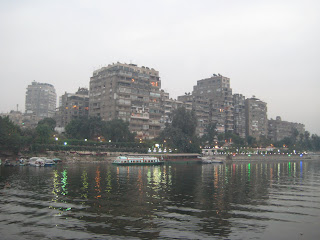 View of the Nile on a cloudy day at twilight. Well, let's be realistic -- it's part dusk, part smog I would guess.
 View of the Nile on a cloudy day at twilight. Well, let's be realistic -- it's part dusk, part smog I would guess.
For those interested in what it's like to live as an expat abroad, here's an article written in a magazine for TCKs. A TCK, or third culture kid, is one who grows up in a culture outside their own or that of their parents, sometimes meaning in multiple countries. This article talks a bit about expat communities and culture, and Egypt is mentioned at the end. My life here is a bit different because I hang out with a younger crowd, not families, but it's still pretty interesting I think.
My other exciting news is that my roommate A2 was in an Egyptian commercial! Some of you may remember that back in August I accidentally auditioned for a commercial. Well, A2 went on another audition and booked the part. The commercial is for Etisalat, an Egyptian phone company. The ad, which is in Arabic, is below. You can catch A2 at the 15 second mark.
Tuesday, November 18, 2008
elsewhere in the middle east...
Egypt feels like the Middle East. Sometimes it's easy to forget when I live in Zamalek, across the street from Cinnabon and Pizza Hut, but most of the time it's pretty noticeable. Still, I thought this article, about expats in Dubai, was pretty interesting.
For good measure, here's one specifically about Egypt and how the country's ancient history coincides with the modern realities of being part of the developing world. Interesting!
By the way -- I throw around the term "expat" often but realized that I never really explained. The word "expat" is short for expatriate, the name for anyone living outside their native country for extended periods of time.
For good measure, here's one specifically about Egypt and how the country's ancient history coincides with the modern realities of being part of the developing world. Interesting!
By the way -- I throw around the term "expat" often but realized that I never really explained. The word "expat" is short for expatriate, the name for anyone living outside their native country for extended periods of time.
Wednesday, November 12, 2008
a little belated, but...
One of my freelance articles is available online now, so I thought I would pass on the link to anyone who'd like to read. The article is about an exclusive food deal for AUC, the American University in Cairo, and was published by ICT Business magazine, a business and IT magazine here in Cairo. You can read it here. Enjoy!
Wednesday, November 5, 2008
YES WE DID
Received today on Cairo Scholars: an e-mail entitled "Congratulations, America."
I watched CNN International from like 12:30-3:30 am, and then woke up at around 5 am to check in again when my dad called me and told me to turn on the TV (I told him to call). I have to admit, I was jealous of those people hanging out in Grant Park with Oprah. That would have been awesome. Anyway, I was trying to avoid writing that post where I talk about how the locals are so informed and everyone here cares about the outcome of the elections more than many Americans I know. (For the record: they are, and they do.)
So instead, I will just say that I am extremely pleased with and proud of America today. Yes we did, indeed.
I watched CNN International from like 12:30-3:30 am, and then woke up at around 5 am to check in again when my dad called me and told me to turn on the TV (I told him to call). I have to admit, I was jealous of those people hanging out in Grant Park with Oprah. That would have been awesome. Anyway, I was trying to avoid writing that post where I talk about how the locals are so informed and everyone here cares about the outcome of the elections more than many Americans I know. (For the record: they are, and they do.)
So instead, I will just say that I am extremely pleased with and proud of America today. Yes we did, indeed.
Wednesday, October 22, 2008
chicago on my mind
As some of you may recall (or may not, whichever), last summer, in June-August 2007, I interned at an investigative magazine in Chicago called The Chicago Reporter. I wrote several articles there and continued to freelance for them during the past year, and I also contributed research to several articles.
One of the articles I helped research was about police brutality in Chicago (you can read it here), a city which has had its share of problems with corrupt cops. Yesterday, one of the most notorious of those cops, John Burge, was indicted. That story is here. It's a really big moment for the people who have spent decades on this case, and it's still pretty big news for anyone who has heard about some of the atrocities he is alleged to have committed (and I have read a lot of those accounts).
Anyway, I know this post doesn't really have anything to do with Egypt, but it's my blog so you get to read about it anyway. And while you're at it, enjoy this as well. (Hint: it involves puppies.)
One of the articles I helped research was about police brutality in Chicago (you can read it here), a city which has had its share of problems with corrupt cops. Yesterday, one of the most notorious of those cops, John Burge, was indicted. That story is here. It's a really big moment for the people who have spent decades on this case, and it's still pretty big news for anyone who has heard about some of the atrocities he is alleged to have committed (and I have read a lot of those accounts).
Anyway, I know this post doesn't really have anything to do with Egypt, but it's my blog so you get to read about it anyway. And while you're at it, enjoy this as well. (Hint: it involves puppies.)
Monday, October 13, 2008
where, oh where, is my absentee ballot?
The living situation has officially been finalized! A2 will move in with A1 and I, which we are excited about because he is a friend, and now we don't have to go through the trouble of screening someone from Cairo Scholars. Also, because we all have the same first initial we can now come up with a catchy name for the apartment. For example, I am pushing for "A-Team," because then we can make Mr. T jokes such as "I pity the fool who doesn't come hang out with us." But I bet my friends have more taste than I do, so I will probably be outvoted.
Other exciting things also happened! The magazine I edit celebrated its 10-year anniversary last week, so we had a big party at the Swiss Club. My boss really went all out, including hors d'oeuvres (I definitely spelled that wrong), an open bar, a live band and a DJ. It was basically a huge expat party, because that's pretty much the target audience for us, and it was cool because I actually knew a bunch of people. Plus I got to bring a lot of my friends, so that was fun as well.
Then another friend was working for a company that was sponsoring a bar opening downtown, so he invited all of us to come. Their theme for the opening was "baladi," the Egyptian word meaning "local," though it is often used in a derogatory way to mean low-class. We tend to use it to describe things that are very typical Egyptian. Anyway, this could not have been more appropriate for this bar, as it was located in a baladi downtown location surrounded by 'ahwas, they served baladi food (aka street food like kofta, ta'ameya, hummous, pita, samboussa), played baladi music, had baladi entertainment (i.e. bellydancers) and gave out baladi souvenirs (scarves and cymbals for the ladies, fez for the men). Overall, it was ridiculously over-the-top Egyptian in a fun way, plus they also had an open bar so we stuck around and had a good time.
A1 and I also decided this week that we could use a little pampering, and luckily that's cheap enough in Egypt. We went to a salon in Mohanessin not far from where I work, a place called Twins. It was just for women, though some of the hairdressers were men. It was not so much a place to get hair cut as it is to get styled -- upper class women just come in to get all done up for a big evening out. It's not a salon as you would think of one -- basically, you come and tell them what you want, and then you sit around chatting in folding chairs and people come to you. The facial-hair-removal operatives are mobile with their eyebrow threaders and mirrors, then you scoot over and the manicure-pedicure come around with large tubs of water for the feet and baskets of nail polish so you can choose your colors. We were just going to get our nails done, but on a whim decided to get our hair straightened as well.
The few times in America that I have attempted to get straight hair, it's always been an ordeal. If it was friends wielding straighteners it could take hours, and it was at the hairdresser it involved complicated products and multiple helpers. This was the easiest thing ever: all the women have thick, curly hair like mine, so it doesn't faze them at all. You just say curly or straight, they blow it out and then start styling. Mine took about an hour, which is the fastest ever. This could have been due to the hardcore straighteners they use, which are literally heated over an open flame. Then they came over to do my nails while I was getting the hair straightened (is that efficient or what?), so I felt like I was in that part of Miss Congeniality where Sandra Bullock is getting the makeover in the warehouse (aka best scene ever). Cost of everything together (manicure, pedicure, eyebrows, hair straightening): LE 80, or about $15. Awesome.
On a more serious note, I have been getting worried because I sent away for my absentee ballot more than a month ago (like seriously, in the beginning of September) and still have not received it. Nice job, state of New Jersey. According to all the other expats I know also freaking out over late ballots, I have other options. If I get it late, FedEx will mail it express back to the states FOR FREE (awesome!), and if I never get it then I can go to the U.S. Embassy and fill in an emergency write-in ballot (officially referred to as a Federal Write-in Absentee Ballot, or FWAB), which they will mail in for me. I think this way I would not get to vote for the NJ stuff, but since I have not really lived in NJ for more than four years and don't plan to be back in the near future, I suppose that doesn't matter as much. I would prefer to send in my regular ballot, but if it doesn't come (I'm giving it one more week before I just go to the U.S. Embassy), at least I can still vote.
Other exciting things also happened! The magazine I edit celebrated its 10-year anniversary last week, so we had a big party at the Swiss Club. My boss really went all out, including hors d'oeuvres (I definitely spelled that wrong), an open bar, a live band and a DJ. It was basically a huge expat party, because that's pretty much the target audience for us, and it was cool because I actually knew a bunch of people. Plus I got to bring a lot of my friends, so that was fun as well.
Then another friend was working for a company that was sponsoring a bar opening downtown, so he invited all of us to come. Their theme for the opening was "baladi," the Egyptian word meaning "local," though it is often used in a derogatory way to mean low-class. We tend to use it to describe things that are very typical Egyptian. Anyway, this could not have been more appropriate for this bar, as it was located in a baladi downtown location surrounded by 'ahwas, they served baladi food (aka street food like kofta, ta'ameya, hummous, pita, samboussa), played baladi music, had baladi entertainment (i.e. bellydancers) and gave out baladi souvenirs (scarves and cymbals for the ladies, fez for the men). Overall, it was ridiculously over-the-top Egyptian in a fun way, plus they also had an open bar so we stuck around and had a good time.
A1 and I also decided this week that we could use a little pampering, and luckily that's cheap enough in Egypt. We went to a salon in Mohanessin not far from where I work, a place called Twins. It was just for women, though some of the hairdressers were men. It was not so much a place to get hair cut as it is to get styled -- upper class women just come in to get all done up for a big evening out. It's not a salon as you would think of one -- basically, you come and tell them what you want, and then you sit around chatting in folding chairs and people come to you. The facial-hair-removal operatives are mobile with their eyebrow threaders and mirrors, then you scoot over and the manicure-pedicure come around with large tubs of water for the feet and baskets of nail polish so you can choose your colors. We were just going to get our nails done, but on a whim decided to get our hair straightened as well.
The few times in America that I have attempted to get straight hair, it's always been an ordeal. If it was friends wielding straighteners it could take hours, and it was at the hairdresser it involved complicated products and multiple helpers. This was the easiest thing ever: all the women have thick, curly hair like mine, so it doesn't faze them at all. You just say curly or straight, they blow it out and then start styling. Mine took about an hour, which is the fastest ever. This could have been due to the hardcore straighteners they use, which are literally heated over an open flame. Then they came over to do my nails while I was getting the hair straightened (is that efficient or what?), so I felt like I was in that part of Miss Congeniality where Sandra Bullock is getting the makeover in the warehouse (aka best scene ever). Cost of everything together (manicure, pedicure, eyebrows, hair straightening): LE 80, or about $15. Awesome.
On a more serious note, I have been getting worried because I sent away for my absentee ballot more than a month ago (like seriously, in the beginning of September) and still have not received it. Nice job, state of New Jersey. According to all the other expats I know also freaking out over late ballots, I have other options. If I get it late, FedEx will mail it express back to the states FOR FREE (awesome!), and if I never get it then I can go to the U.S. Embassy and fill in an emergency write-in ballot (officially referred to as a Federal Write-in Absentee Ballot, or FWAB), which they will mail in for me. I think this way I would not get to vote for the NJ stuff, but since I have not really lived in NJ for more than four years and don't plan to be back in the near future, I suppose that doesn't matter as much. I would prefer to send in my regular ballot, but if it doesn't come (I'm giving it one more week before I just go to the U.S. Embassy), at least I can still vote.
Thursday, September 25, 2008
pretty pictures
I know I have written lots of posts about Ramadan, but a friend sent me this gallery of photos of people observing Ramadan around the world. I think they really show the best parts of this past month -- yes, there are a lot of rules and it can be frustrating sometimes, but overall there's a great spirit about this holiday. Enjoy!
Sorry for so many short posts this week -- we have a deadline this weekend and I have been pretty busy. I will post something longer next week.
Sorry for so many short posts this week -- we have a deadline this weekend and I have been pretty busy. I will post something longer next week.
Tuesday, September 23, 2008
reasons i will not be leaving cairo this weekend
Tourists have been kidnapped in Upper Egypt. Read about it here and here.
At first we didn't see anything about this reported in the Egyptian press (that wouldn't be a first in this country, sadly), but now it's all over the media. That second link is to The Daily News Egypt, a reliable English daily paper that comes as an insert in the International Herald Tribune.
At first we didn't see anything about this reported in the Egyptian press (that wouldn't be a first in this country, sadly), but now it's all over the media. That second link is to The Daily News Egypt, a reliable English daily paper that comes as an insert in the International Herald Tribune.
Monday, August 18, 2008
franzia for president
Wow guys, sorry I'm lame. See, my life isn't always exciting -- yesterday I wrote about microwaves. To make up for it, here are some non-boring news stories. Enjoy!
I think the most important item I have read today is that The New York Times hearts Franzia.
In Egypt news, not everyone is a fan of women-only beaches. Check the end for some excellent hypocrisy from the men interviewed.
Also, women say wearing a hijab (headscarf) doesn't prevent you from getting harassed. I know I have written a couple times about harassment of women in Egypt, and the reason is because it's something that we just continue to marvel over. It's just so blatantly prevalent (and kind of disturbing), and rather than trying to get men to stop...they tell women it's their fault and they should cover up more. The Washington Post article I linked to above references an e-mail campaign urging women to be more modest. There's a version of that ad below, comparing veiled women to the covered lollipop, and unveiled women to the fly-covered lollipop. The text says "You can't stop them, but you can protect yourself." And they wonder why women in Egypt are harassed...

I think the most important item I have read today is that The New York Times hearts Franzia.
In Egypt news, not everyone is a fan of women-only beaches. Check the end for some excellent hypocrisy from the men interviewed.
Also, women say wearing a hijab (headscarf) doesn't prevent you from getting harassed. I know I have written a couple times about harassment of women in Egypt, and the reason is because it's something that we just continue to marvel over. It's just so blatantly prevalent (and kind of disturbing), and rather than trying to get men to stop...they tell women it's their fault and they should cover up more. The Washington Post article I linked to above references an e-mail campaign urging women to be more modest. There's a version of that ad below, comparing veiled women to the covered lollipop, and unveiled women to the fly-covered lollipop. The text says "You can't stop them, but you can protect yourself." And they wonder why women in Egypt are harassed...

Subscribe to:
Posts (Atom)


 Posts
Posts

